Dear London, after dark,
We see you.
You are more than a few bright lights and late nights – you are part of this city’s DNA. You are where stories are told, friendships are formed, ideas are sparked, and culture comes alive. From the hum of night buses to the rhythm of live music to the laughter spilling from late-night restaurants, pubs and theatres – you remind us that the night is not an ending but another beginning.
We imagine a city that breathes after dark. A London that fully embraces being 24 hours – where people can work, connect, create, eat and celebrate at all times. Where late-night activity isn’t seen as a nuisance, but as vital culture: the heartbeat of the capital carried in basslines, conversations and the low hum of a city alive after dark.
We see diverse scenes for diverse people. From underground queer clubs to rooftop cocktail bars, from grime nights in outer boroughs to community halls, jazz cafés, shisha terraces, and night markets – a kaleidoscope of spaces where everyone feels welcome. Places to dance, to talk, to rest, to reflect.
We see a city that is local and global, side by side. Small venues thriving next to iconic institutions and centuries-old pubs; fringe theatres and hotel bars sitting shoulder to shoulder with world-class clubs. A London that celebrates its cultural exports – jungle, garage, grime, UK funky and more – while embracing global flavours and influences.
We see public spaces reclaimed. Beautifully lit parks open late, safe streets alive with conversation, canalside food trucks, plazas hosting night markets, buskers, open-air cinema, and families and night-shift workers sharing the same public realm. Public infrastructure built not just for commuting but for joy and connection.
We see a nightlife that is safe, supported and respected. Where everyone – from DJs to door staff, cab drivers to chefs, bar staff to street pastors, hotel concierges to cleaners – is recognised, valued, and fairly paid. Where safety is built in, not bolted on. Where women, queer people, and marginalised groups feel confident, not cautious. Where the police and night creators find new space for collaboration and compromise.
We see a future that is sustainable and smart. Green, creative, and tech-forward forms of nightlife powered by energy-efficient venues, waste-free kitchens, decarbonised transport, and noise-conscious design. Smart lighting that welcomes people in, digital tools that support wellbeing, and technology that opens new creative frontiers.
We see joined-up governance. A London where the Mayor, councils, Transport for London, licensees, planners, cultural institutions and the Metropolitan Police move in harmony – building a nightlife that is vibrant, safe, and economically resilient. A new civic contract where planning, policy, and community vision work together in support of our shared goals.
And above all, we see a culture of care. For the spaces we share, for the people we party and work with and for the communities around us. A nightlife rooted in consent, compassion, and creativity. A nightlife that supports mental health, champions inclusion, and values itself as a public good.
This is our love letter to our city – to a London that never sleeps, belongs to every one of us, as Londoners, and shines even brighter after dark.

Cameron Leslie

Alice Hoffmann-Fuller

Georgina Wald

Kate Nicholls

Lily London

Michael Kill

Nadine Noor

Nathanael Williams

Provhat Rahman

Sam Spencer

Sophie Brownlee
In February 2025, the Mayor of London appointed an independent Nightlife Taskforce to look into the present-day realities of London’s nightlife and to make a set of recommendations for protecting, supporting and strengthening the sector. This report is the culmination of that process.
Over the course of 2025, the Taskforce worked alongside VibeLab and in partnership with the Greater London Authority (GLA), to carry out research, collate evidence, host round tables, interview experts, discuss countless different ideas, and ultimately agree on the ten recommendation areas.
We know that none of the issues facing London’s nightlife have straightforward solutions. Nightlife is under pressure from a combination of factors including, but not limited to, the cost of living and doing business crisis, prohibitively complex licensing and regulatory processes and competing demands for urban space. These recommendations are not a magic bullet – but together outline a path towards better supporting and sustaining nightlife in the capital.
We believe these recommendations set out a fundamental shift in London’s night time governance, regulation and policy-making: built on the clearest and most robust evidence base ever collated on the topic, informing bold new ideas for how we might move forward together as Londoners.
Whatever your relationship to nightlife, this report is for you. Whatever brings you into the city after dark, we want this report to make you feel more informed, empowered and optimistic about London’s nightlife. To believe, as we do, that our experiences after dark are worth fighting for and investing in; and that by doing so we can make them even better.
Nightlife makes us who we are as Londoners. A majority of the people we surveyed go out at least once a month. 60% said that nightlife helps them feel more connected to their local community and 49% of people said it influenced their decision to stay in London – a figure which rises to 73% among the tech and IT sector.
Our governance and policy-making structures must mirror this: involving more diverse perspectives, enabling the collective and collaborative potential of London’s nightlife ecosystem, and reflecting nightlife’s critical role in shaping not just London’s identity but that of the UK as a whole.
This means creating a new, permanent Nightlife Commission for London, made up of experts from across the city’s nightlife sector. The Commission will be an independent body, working in close collaboration with the GLA, local councils, the Metropolitan Police and other groups to guide, inform and improve London’s night-time policies and decision-making.
The Commission will be supported by a network of research and working groups, each focused on specific topic areas, offering further opportunities for the nightlife sector to get directly involved in how the sector is supported and empowered.
Among those who responded to our survey, 57% said they wanted to see more support for grassroots cultural spaces.
This led us to a new, more encompassing definition which states that nightlife is the evening, night time and early morning spaces where people meet, ideas are exchanged, cultures are expressed, and creativity happens. It is this reciprocal mix of the cultural and social that makes nightlife both unique and special:
Nightlife is made up of the activities, events and spaces that encourage social and cultural participation primarily between 6pm–6am.
By providing spaces and opportunities for Londoners, communities, artists and the creative and cultural sectors – nightlife is considered culture. Both its social benefits and cultural significance must be recognised, alongside its contributions to London’s night-time economy.
Embedding the idea that nightlife is culture is an important next step, that includes: the Mayor of London, councils and other public bodies adopting this definition; including it in key policies such as the London Plan and updating other policies and schemes to include nightlife; and advocating for the inclusion of nightlife as a sector that is officially supported and championed by the UK Department for Culture, Media and Sport.
This affects businesses, audiences and workers. More than two thirds (68%) of the 18 - 30 year olds we surveyed felt that current economic conditions have caused them to participate less in nighttime activities. VAT and business rates were raised as issues by 68% of venue owners, with energy bills and rents being highlighted by 67% and 60% respectively. 92% of the night workers we surveyed ranked low pay as the biggest challenge to their wellbeing. These pressures are felt most sharply amongst the grassroots, where culture may already be vulnerable or marginalised.
The Mayor of London and the Greater London Authority should help with this by lobbying for a national nightlife business rates reform and a cost relief scheme for nightlife spaces, the scaling of National Insurance contributions based on turnover, and energy cost support.
Almost half (47%) of survey responses received by the Nightlife Taskforce expressed a desire for more inclusive nightlife, from safer LGBTQ+ spaces to more culturally diverse programming. 29% of respondents raised issues around economic accessibility and 28% mentioned support for emerging artists and scenes. Other research suggests that 39% of 18 to 24-year-olds do not drink alcohol even if they remain engaged in various forms of late-night culture.
The creation of a Nightlife Future Fund, delivered in partnership with the Nightlife Commission, providing startup funding for new ideas, will help to empower underrepresented groups, drive innovation, and create barrier-free pportunities for the development of groundbreaking nightlife.
This is reflected in other data, with research from the Music Venues Trust and Autonomy Institute showing that the cost of running a venue is increasing, while people’s disposable income - and therefore the amount of money they can afford to spend on a night out - is decreasing. This creates negative knock-on effects for workers, promoters, audiences and artists.
Many of London’s most exciting and successful nightlife venues started as “meanwhile” projects in otherwise vacant spaces. Defining and regulating these spaces more effectively, by creating new fast-track licensing and planning classifications for temporary nightlife use, will make it easier and more affordable to start and sustain these kinds of venues.
The new Nightlife Commission should also be able to access a new centralised register, tracking vacant and under-used properties with potential for change of use or temporary nightlife activation. This will help connect promoters, operators and cultural organisations to find the spaces they need, reducing vacancy, stimulating local economies and expanding affordable cultural opportunities.
24-hour infrastructure makes a global city, and a city truly global. Safe and reliable late-night transport; appropriately lit public spaces; 24-hour services and extended cultural and retail opening hours will enable Londoners to live, work and socialise beyond the traditional ‘9–5’ framework. This will make the city more productive and inclusive, supporting everyone from nurses and cleaners to artists, logistics workers, hospitality staff and all those that for need or choice engage with the city throughout the night.
The Mayor of London, boroughs, Transport for London and the Police can foster and support 24-hour infrastructure by embedding the 24-Hour City Test across all GLA policies and programmes, encouraging and supporting boroughs to do the same by developing local Night Time Strategies, and funding initiatives which foster cultural, social, economic activities to ensure London works for everyone equally around the clock.
Mapping late-night footfall data onto transport routes helps to explain some of these concerns: our demand for transport changes throughout the night (for example, when large events finish) but service provision doesn’t always align with these patterns because of how the network is designed around long-term patterns of demand, rather than short-term or event-specific peaks.
The re-establishment of the GLA’s Late Night Transport Working Group could be critical to coordinating and implementing these and other changes.
This includes the costs associated with soundproofing, the knock-on effects of reduced volume levels for venues, the time and stress involved in navigating complex noise complaints procedures, and the risk of vexatious complaints tying operators up indefinitely in bureaucratic hurdles.
A more modern approach to managing sound in the city and legislative reform to noise enforcement can help to address these issues. A new Noise Mediation Pilot could supplement subjective complaints with real-time data, setting clearer thresholds for disputes and guiding fair mediation. The Agent of Change principles must be strengthened across licensing, environmental protection and planning to provide additional protections for nightlife.
The Mayor of London and the Greater London Authority must also lobby for changes to the Environmental Protection Act 1990 to find a better balance between residents and cultural spaces, requiring a minimum of ten unrelated households to complain before investigations into licensed venues are triggered, mimicking the success of Vibrancy reform in places like New South Wales.
This is reflected in the survey data collected by the Taskforce, which suggests that a majority of venues have to contact the police rarely (30% of responses) or occasionally (35%). Owners and operators are most concerned about theft (54%), noise complaints (30%) and drug-related issues (30%).
This doesn’t mean that safety can be taken for granted though: from phone thefts outside venues to violence against women and underrepresented groups, it’s clear that safety risks remain varied and complex to resolve.
This requires rebuilding trust between the nightlife sector and the Police, moving from an enforcement-first mindset to a genuine partnership approach. In order to achieve this, there should be an assessment of that relationship. A shared licensing framework under the Mayor of London’s new Strategic Licensing Project could help build clear, consistent standards across London. By using real data on footfall and crime, police resources could be deployed more proportionately and effectively – supporting safer nights without penalising nightlife itself.
Harm reduction policies must be placed at the centre of the Metropolitan Police’s approach, instead of zero tolerance: prioritising de-escalation, early intervention and support over punitive measures. Harm reduction policies encourage collaborative working between operators and the Police, which is desired by all.
More than half of the nightlife spaces (53%) which responded to our survey described London’s licensing process as overly complex, lengthy and expensive, while 64% of promoters said they’d faced difficulties around Temporary Event Notices. Perceptions of planning rules were similar: the overwhelming view was that these systems are outdated, arbitrary and stifling London’s nightlife.
Relationships are suffering as a result: nightlife operators told us that they don’t fully trust authorities, with a perception that some Police teams and councils don’t fully recognise the value of nightlife, and a lack of open communication. In other areas, people highlighted the amazing work being done locally in planning and licensing. This shows the need for and potential benefit of consistent standards and a shared understanding of nightlife’s value across London’s authorities, so that partnership becomes practice, not chance.
Addressing this should include piloting the National Licensing Taskforce ambitions into a London Strategic Licensing Policy and service, removing Cumulative Impact Assessments, prioritising London Plan classifications of areas suitable for nightlife use, and developing a London Licensing Operating Standard to deliver cross-borough consistency.
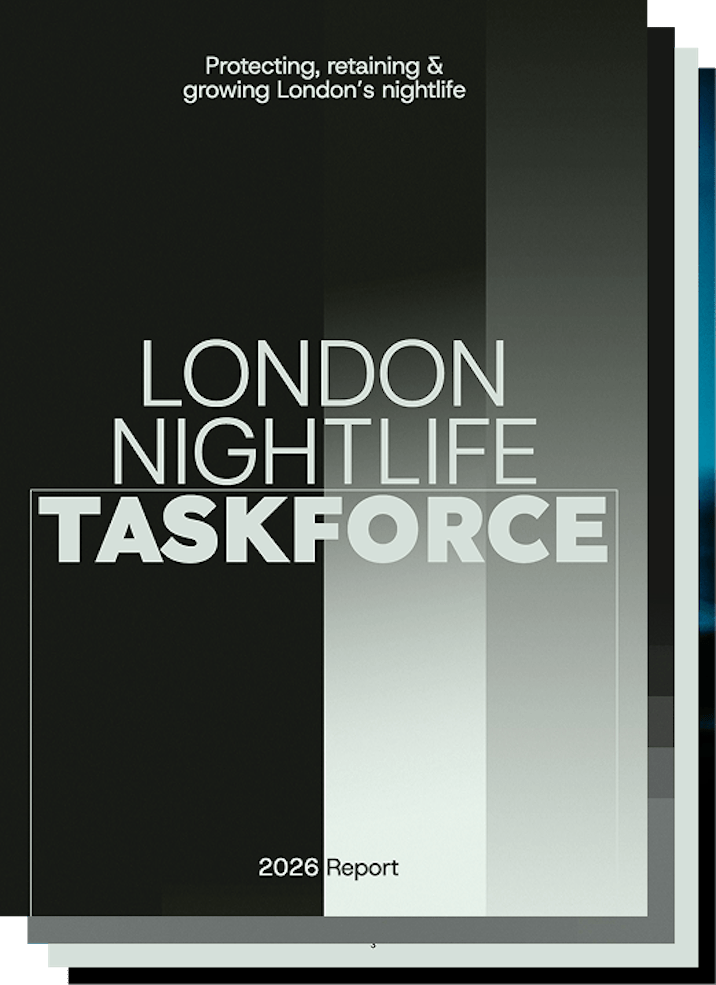
In February 2025, the Mayor of London announced a new independent Nightlife Taskforce. This brings together a range of experts from the frontline of the capital’s nightlife, tasked with helping to support the capital’s life at night.
In 2025, the Taskforce met regularly to examine the issues facing London’s nightlife; commission new research; and ultimately provide recommendations to the Mayor so that the city’s night-time culture, communities and economy can thrive. This report is the culmination of that process.









Greater London Authority: 24 Hour London The 24-Hour London team is responsible for delivering on the Mayor’s vision to make London a safer, fairer, more prosperous and sustainable city around the clock. Current work includes strategic licensing reform, data-led research into night workers, helping boroughs to create effective night time strategies, prioritising women’s safety through the Women’s Night Safety Charter, cutting red tape for businesses via business-friendly licensing, increasing al-fresco dining opportunities with the Summer Streets Fund, addressing racial inequalities in music event licensing through the REMEL project, and delivering London’s first Nightlife Taskforce of frontline industry experts to address the challenges facing London’s nightlife.
Sam Mathys
Project Lead
Julieta Cuneo
Research Lead
Francesca Gluščević
Project Officer

VibeLab is a data-driven research, consultancy and advocacy agency dedicated to supporting creatives and preserving night-time culture. With over ten years of experience, VibeLab works with local institutions and governments to develop effective strategies that support and navigate the nightlife industry. We specialise in making complex data clear. VibeLab’s research and consultancy help identify growth opportunities and connect individuals, businesses, governments, and institutions to boost creativity and local economies. We are passionate about the transformative power that nightlife culture and creative communities have in urban areas. Our strength lies in our connections: we bridge the gap between government authorities, nightlife creatives and local communities. VibeLab creates change with sustainable solutions, backed by data to make cities thrive at night.
Lutz Leichsenring
Lead Consultant
Amir Salem
Project Lead and Manager
Diana Raiselis
Research Design and Report Lead
Ed Gillett, Diana Raiselis,
Amir Salem, Kerronia Thomas
Report Writers
Jane Slingo
Report Development
Mirik Milan
Project Consultant
Michael Fichman (PennPraxis, University of Pennsylvania)
Project Advisor
Jack Waghorn
Graphic Designer
Thamar Luthart
Creative Direction
This project recruited London-based specialists to lead in-person research engagements.
Nate Agbetu (Free Form)
Kelsea Delatango (Bare Radicals)
Ali Wagner (Dancefloor Intimacy)
Research Engagement Leads

The Autonomy Institute is an independent organisation specialising in data-driven research, policy design, and consultancy to reimagine work, welfare, and sustainable economies. Founded in 2017, we translate complex challenges—such as the four-day working week, economic transitions, and environmental justice—into practical, actionable policies for governments, organisations, and communities. Our Autonomy Data Unit (ADU) crafts bespoke digital tools to power initiatives from governments and forward-thinking institutions. By bridging advocacy, research, and digital innovation, we deliver strategic insights to reduce working time, support fair transitions, and strengthen local economies. We believe actionable data empowers a fairer—and more sustainable—future for all.
Julian Siravo
Lead Researcher and Data Analyst
Luiz Garcia
Lead Researcher and Data Analyst

UCL Consultants: UCLC researchers Professor Ben Campkin and Dr Alessio Kolioulis are leading researchers of night-time urbanism. They are based in The Bartlett Faculty of the Built Environment, ranked number 1 in the world for architecture and the built environment (QS World Rankings, 2025). In collaboration with Dr Lo Marshall, they undertake transdisciplinary research in partnership with city authorities, grassroots organisations and other partners to shape policy, public and academic debates on cities after dark. Recent collaborative projects have brought the voices of night workers, LGBTQ+ communities and migrant populations into policy, professional and public discussions.
Professor Ben Campkin
Lead Consultant and Advisor
Dr Alessio Kolioulis (Night-time economic analysis)
Senior Consultant and Report Writer
Allie Lester
Policy Research and Data Analysis